
Creating a generation of power users

Let's start with a distinction that doesn’t get the right level of attention.
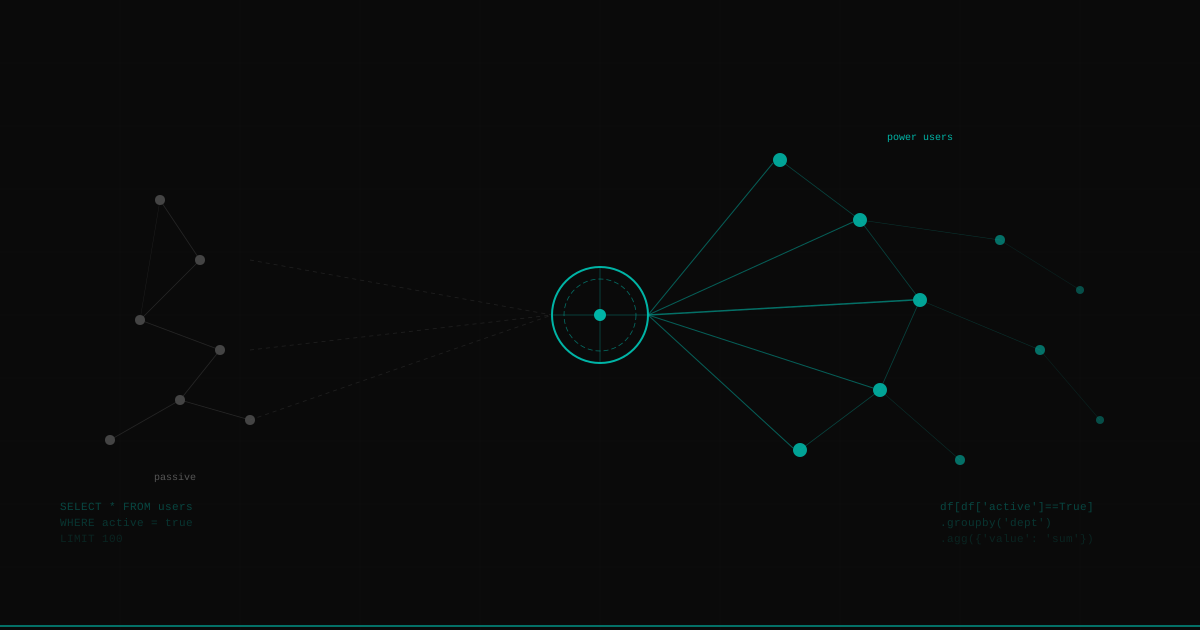
In your organization right now, you have passive data consumers and active data consumers. Passive consumers want reports in their inbox every Monday morning, formatted in Excel with formulas, "just in case someone asks." You're not their data enablement; you're their CYA. Active consumers get an initial report, dig in, ask a follow-up question. Can we go back a couple years and see if there's a trend? Their ears perk up when they hear they can interact directly with the data. Over time they start masterminding how data capabilities might change their entire department's function.
Historically we'd treat these two groups the same. They're not the same.
Passive consumers participate in performative analytics. Active consumers see data as a mechanism for change. I appreciate both groups (they're all my customers) but only one of them is the target here.
Here's why that distinction matters more than most data leaders acknowledge: a three-person data department is three people strong. An organization that creates a robust data function, on the other hand, is as strong as the number of people you train to use your tools and your curated data. The multiplier isn't headcount. It's how many active consumers you can convert into power users.
The gateway drug is SQL
It's not unreasonable to get a moderately motivated person started with SQL in an afternoon. Can you type SELECT * FROM table? Congratulations! You can use SQL.
Literally sit a potential power user down and have them type that into your BI platform. Watch how they respond when that simple command returns a clean table of results. If their eyes go wide, you have something to work with.
That's your starting point. From there you're building competency.
The crosswalk to Python
The jump from SQL to Python feels bigger than it is. The trick is creating a direct crosswalk. Like, what’s the Pandas equivalent of WHERE? Of HAVING? Of GROUP BY? When someone can map a concept they already understand onto a new syntax, the learning curve gets flatter.
In my shop we're running AWS for storage and Snowflake for compute, and my current goal is getting staff more conversant in Python to bring up Streamlit capabilities. The ability to quickly push out interactive views has real potential to simplify our stack and put more power directly in the hands of the people who know their data domains best. I would like to promote the concept of enablement as a top-3 data office responsibility.
For Phase I I've landed on six libraries as the core curriculum: Pandas, NumPy, Seaborn, Plotly, Matplotlib, and Scikit-learn. Of those, Pandas is the one that gets the most concentrated attention. It's the library that most directly maps to how SQL-native thinkers already see data — tabular, filterable, transformable. Get someone comfortable in Pandas and the rest of the stack starts to make sense.
I have a lot more to say about the specifics of upskilling curricula… a lot... and I'm saving that for another day. What I'll say here is that the library choice is less important than the sequencing, and the sequencing is less important than knowing which people in your organization are actually ready to make the jump.
What a power user organization looks like
When this works, something shifts. The data function stops being a service desk and starts being infrastructure. Your active consumers stop submitting tickets (or emails) and start building. Your three-person team is still three people, but the organization it supports is operating at a completely different level of data fluency.
This exercise gets your office further up the Maslow hierarchy of data needs. Get more business users in the self-service layer, and that frees up more of your staff to move into ML and early quantum research.
That's the goal. Not more analysts. More people who think like analysts.